
A coin is struck in two steps. First a disc — the planchet — is punched out of a metal strip. Then it is squeezed between two dies: one strikes the obverse, the other the reverse. Something can go wrong at every step, and then a coin with an error goes into circulation. Usually it is worth no more than a normal coin, but some kinds of errors are actively hunted by collectors.
Planchet errors
- Clipped planchet — a curved bite seems to be missing from the edge. It happens when a new planchet is punched partly over the spot where the previous one was already cut out.
- Wrong planchet — the coin was struck on a disc prepared for another denomination. Weight and size give it away: they do not match the catalogue, but they do match a different coin.
Die errors
- Die crack — the die cracked, and every coin it struck afterwards carries a raised line or lump. The longer the die stayed in use, the more visible the mark.
- Rotated die — the dies are set at an angle to each other. Russian coins use medal alignment: turn the coin around its vertical axis and the other side is upright too. On a coin with a rotated die it is tilted. The larger the angle, the better the find; a 180° rotation is valued most.
- Wrong die — one side was struck with a die from another coin or another year. Russian collectors call such coins "perepoutki", mix-ups.
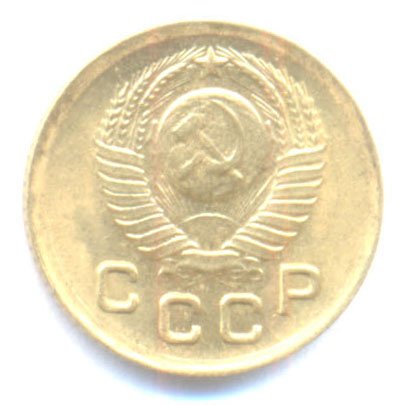
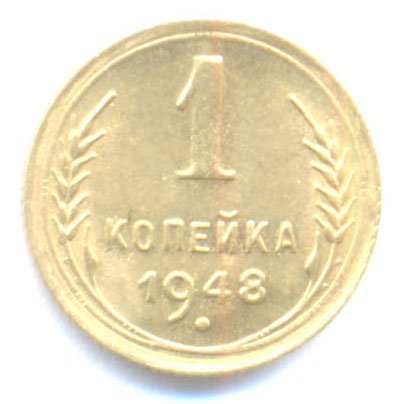
Something similar happened to the 1957 kopecks. Kopecks of 1948–1957 were struck with a coat of arms whose ribbon has 16 turns; in 1957 the arms on the coins changed and the ribbon got 15 turns. So coins of that year exist with both versions, and catalogues list them as separate varieties.
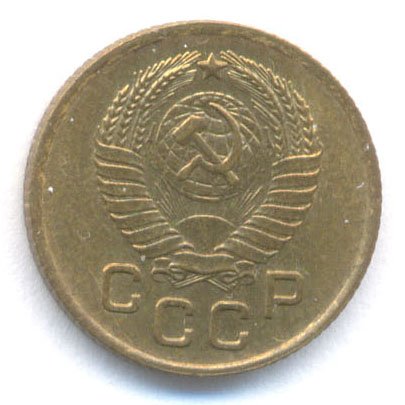
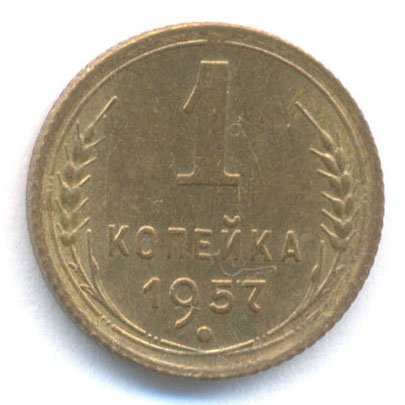
1 kopeck — USSR (1948–1957), 1957
Photo: АукционЪ.СПб · auction.spb.ru
Striking errors
- Brockage — a struck coin stuck to the die, and the next planchet was impressed by that coin instead of the die. One side looks normal; the other shows the same side again, but incuse and mirrored.
- Double strike — the coin was struck a second time off-centre, and the design is doubled. If both images are identical it is a double strike; if they differ, the coin was overstruck on another one.
- Weak strike — part of the design came out faint or did not appear at all: the blow was too weak or there was dirt in the die.
Error or damage
A coin scratched, bent or worn in someone's pocket is not an error but damage, and it has no collector value. Errors are born at the mint, so their signs are part of the coin: a die crack is raised, not scratched in; a coin on a wrong planchet weighs exactly what the other denomination weighs; the mirrored image of a brockage is pressed in evenly and sharply. If in doubt, show the coin to a specialist.
Where to start
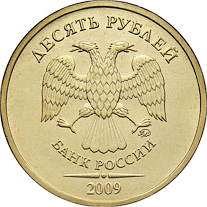
Rotated dies and die cracks turn up in everyday change — just look closely. Photos of normal coins in the catalogue help to compare, for example the 1 rouble of 2009–2015 or the 10 roubles of 2009–2015.


Photo: cbr.ru